Tag Archives: Japanese MAGLEV (Magnetic Levitation) Trains

How about PARIS – TOKYO by MAGLEV (Magnetic Levitation) Train ?


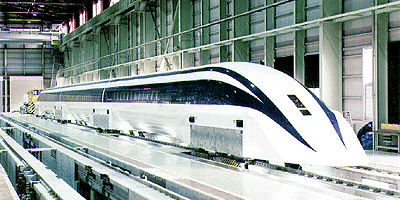
JR-MAGLEV Series_L0  (Wikipedia)

JR-MAGLEV Series_L0 (Wikipedia)

MAGLEV (Magnetic Levitation) Train Applications are being developped, tested and slowly implemented in China and in Japan. What about one day a MAGLEV service speeding at an average speed of 500 km/h and linking Paris – Brussels – Berlin – Warsaw – Moscow – Pekin – Osaka – Tokyo in one day, competing with airplanes?

Find out more in this paper (in French) of Pr Jean Englebert:

Article -Maglev Jean Englebert 2007

*****************************************************************************

About Jean ENGLEBERT (in short):

• Civil Engineer and Architect (1955, University of Liège).

• Engineer and town-planner (1958, University of Liège).

• Full-time Professor at the Applied Sciences Faculty (University of Liège),

Architectonic and Urbanistic Composition, 1966-1994

. Emeritus professor 1994

• Founder and director of the Research Centre for Architecture and Town-planning

of the Liège University (CRAU), since 1967.

. Founder member in 1991 and President of CÉJUL (Centre for Japanese Studies at Liège University)

. Decorated of ” The Order of the Sacred Treasure, Gold Rays with Neck Ribbon,”

by His Majesty the Emperor of Japan the Twenty – ninth of the Fourth Month of the Seventh Year of Heisei (1995 ).

. Appreciation Prize 1998 of the A.I.J. (Architectural Institute of Japan).

Are Japanese MAGLEV (Magnetic Levitation) Trains the next thing?


Japanese MAGLEV (Magnetic Levitation) Trains

Japanese MAGLEV (Magnetic Levitation) Trains


Why MAGLEV?

Magnetically levitated (MAGLEV) trains are considered as a future application of HTS development. To understand why, we must look briefly at the history of the railroads. The development of trains and rails began in the early 1800s. The modern conventional train is no faster (~110 mph) than those of the late 1890s. So conventional trains have reached the end phase of their development.

France, Germany, and Japan have developed “high-speed” or “bullet” trains capable of speeds of 150-180 mph. This improvement in speed is based upon improved rails and controls. However, this technology has also reached the end phase of its development. One limiting factor for these trains is the expensive and time-consuming maintenance of the rails. So it is the mechanical friction between train wheels and metal tracks that limit this technology. This leads us to the development of the magnetically levitated (no friction) trains.

Read more from:   http://www.lanl.gov/orgs/mpa/stc/train.shtml

.

The Chuo Shikansen MAGLEV Project from JR Tokai – JR Central

While its fastest bullet trains can cut the transit time from Tokyo to Osaka from about 6 hours by car to about 2 hours and 20 minutes by bullet train, JR Tokai is dreaming of a next generation maglev system that could go even faster, completing the 500+ kilometer (310+ mile) journey in under an hour.

The Chuo Shinkansen Maglev, a $90B USD Project: a superconducting magnetically levitated (SCMaglev) train design (a type of electrodynamic suspension Maglev), which travels along a U-shaped track at speeds of up 505 km/hr (311 mph).

Read more from:

http://www.dailytech.com/Japanese+Maglev+Train+Begins+Full+Speed+Testing+at+310+mph/article33281.htm

.

Want to see what it feels like in such a train (at 500 km/h)?

Check the following demo video:

https://www.youtube.com/watch?v=DDmH7dfpl0Y


Design a site like this with WordPress.com
Get started