Tag Archives: Japan

Testing Plasma cluster Ion Technology (Source – Sharp Corp)
“Sharp Corporation announced on November 17 that it has found its air purifying technology is effective to inhibit bird flu virus.
Sharp plans to develop air cleaners and air conditioners using the “Plasma cluster Ion” technology to help prevent infections of the disease to humans.
Sharp conducted a joint research with Pasteur Institute in Ho Chi Minh City, Vietnam. They found that highly concentrated ions generated using the technology can decrease the infectiousness of H7N9 virus by 99 percent in a container box of 1 cubic meter for about 47 minutes.” (Source: EU-Japan Centre)
More details from (in Japanese): Sharp’s Air Purifying Technology Found Effective against Bird Flu
Leave a comment | tags: air cleaners, air conditioners, Air Purifying Technology, Bird Flu, GBMC, H7N9 virus, Japan, Plasma cluster Ion Technology, SHARP, Sharp Corp | posted in Business, Japan, Social, Technology

eiken logo (Source – Eiken Foundation of Japan)
“About 70 to 80 percent of third-year junior high school students failed to attain level 3 of the EIKEN Test in Practical English Proficiency in all areas except writing, a government survey has revealed.” (The Mainichi Shimbun)
This is not new but there is still much way to go! Considering Japan’s efforts towards internationalisation, what should be done to improve the situation?
More details from: According to MEXT, 70-80% of third-year junior high schoolers fail to reach level 3 in English exam
Leave a comment | tags: eiken, Eiken Foundation of Japan), english, english learning, english teaching, GBMC, Japan, MEXT | posted in Cross-cultural, Japan, Social

Transceiver CMOS chip and module (Picture – Adalidda)
“Tokyo Institute of Technology and Fujitsu Laboratories Ltd. today (1 February 2016) announced that, in an effort to further enlarge the capacity of wireless equipment, they have developed a CMOS wireless transceiver chip that can process signals at high speeds with little loss across a broad range of frequencies, from 72 to 100 gigahertz (GHz). They also developed technology to modularize it. With these developments, they succeeded in achieving wireless transmission speeds of 56 Gigabits per second (Gbps), the world’s fastest.” (Source: Adalidda)
Impressive! What’s next?
More details from: Tokyo Institute of Technology and Fujitsu Achieve Wireless Transmission Speeds of 56 Gbps, World’s Fastest
Leave a comment | tags: CMOS chips, CMOS transceivers, CMOS wireless transceiver chips, Fujitsu, GBMC, Japan, Tokyo Institute of Technology, transceiver modules, wireless, wireless transmission, Wireless Transmission Speeds of 56 Gbps | posted in Business, Japan, Technology

The future of robotics
“A committee of experts to discuss an international robot competition that the Japanese government wants to hold in 2020 met for the first time on Feb. 2, and suggested that the competition cover three categories: product-making, services, and public interest projects.
“Product-making” would cover fields like factory work and agriculture. “Services” events would include areas like customer service and providing care for the infirm. “Public interest” would cover fields like checks on public infrastructure and disaster rescue operations.” (The Mainichi Shimbun)
Japan(2020) = (Olympics + Robots) x C2 !
Great but to which extend should humans push for robot development?
More details from: Japan is planning an “International Robot Competition” in 2020!!!
Leave a comment | tags: 2020, EU-Japan cooperation in Robotics, GBMC, International Robot Competition, Japan, Japanese robotics, robotics, robots, Tokyo Olympics 202 | posted in Business, clever software, Japan, Social, Technology

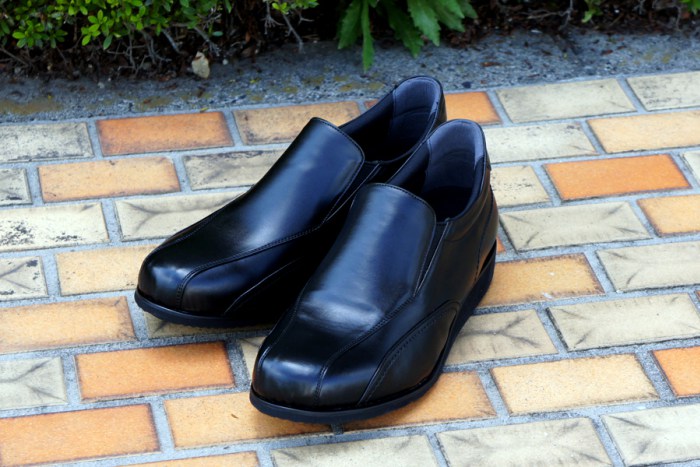
Docodemo GPS Shoes (Picture – Docodemo)
” A Kyoto-based company has started selling shoes with the global positioning system to help track down dementia-suffering seniors who wander off and often get lost.
The company which runs nursing homes experienced their inhabitants were getting lost for a short period of time. That was the reason for the company deciding to develop a special apparatus to prevent similar incidents.
The GPS terminal is implanted in the left heel of the “GPS Dokodemo (everywhere) Shoes,” and enables family members and caretakers to monitor the wearer by using smartphones or computers.” (Source: EU -Japan Centre)
Great idea! Maybe this could also be used to track (younger) loved ones, lost while shopping in Department Stores or Shopping Malls? What kind of application would you like to suggest?
More details from (in Japanese): GPS Shoes to Help Track Elderly People with Dementia
1 Comment | tags: dementia, dementia in Japan, Docodemo, Dokodemo, GBMC, global positioning system, GPS shoes, Japan, track elderly people, tracking | posted in Business, Japan, Social, Technology

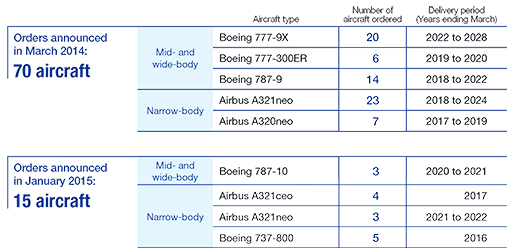
ANA_orders (Source – ANA)
“ANA is likely to become an A380 operator, with three aircraft due for delivery from 2018. Operating the A380 was not in ANA’s plans. In fact, as ANA itself has itself stated, there are many arguments against taking A380.
The aircraft order appears to be a trade-off: ANA won the last minute support of Airbus to vote for its restructuring plan of the bankrupt Skymark Airlines. There was little obvious reason for Airbus to back ANA, a tiny Airbus customer, over the alternative restructuring plan proposed by Delta, itself a major Airbus operator. It may be that in exchange for Airbus’ support ANA agreed to do more business with Airbus.” (CAPA – Center for Aviation)
Looking forward to more A380 and other Airbus orders (and, therefore, less Boeing orders) for the Japanese Market!! What do you think?
Read more from: ANA and the A380: Airbus wins a new customer in return for invaluable Skymark support
Leave a comment | tags: A380, aerospace, Airbus in Japan, ANA, Delta, EU, GBMC, Japan, Skymark Airlines | posted in Business, EU, Japan, Technology

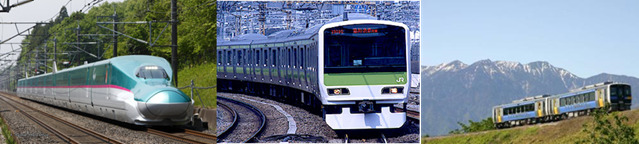
JR East Trains (Picture – JR East)

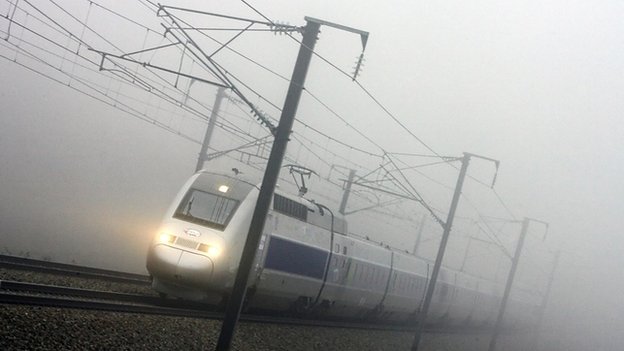
TGV_Alstom (Picture -Alstom)
“Merseytravel, an executive body that provides professional, strategic and operational transport advice to the Liverpool City Region Combined Authority, announced on 11 January 2016 that five bidders including a team composed of French and Japanese companies have been shortlisted for a contract to supply around 50 EMUs (Electric Multiple Units) for the Merseyrail network.
The Franco-Japanese team is composed of Mitsui, a major Japanese trading company, J-TREC, JR East’s subsidiary rolling stock manufacturing company, and France’s Alstom.
Bids are due to be submitted by the end of April and a preferred bidder will be identified towards the end of the year. The project is likely to cost around £400m.
This joint action between French and Japanese companies is the first of its kind in the European Union, and concrete business results are expected.” (Source: JR East Newsletter #19)
More details about the bid at: Railways Business: Franco-Japanese team shortlisted for new UK trains!
Looking forward to more Europe-Japan collaborative projects on both sides!
This is probably the right approach to promoting the completion of an EU-Japan EPA!
What do you think?
About J-TREC:
“Japan Transport Engineering Company is a total transport engineering firm manufacturing rolling stock, cargo containers, railway tracks and turnouts with its 100% of stocks owned by East Japan Railway Company. Rail transport nowadays has become a part of modern social infrastructure and the pursuit of safety, assurance and comfort are at the core of our manufacturing philosophy. Along the pursuit, our belief in manufacturing is to pay attention to every detail, even to those that are not visible at a glance.
The forerunner of our company is Tokyu Car Corporation which has realized the first domestic production of stainless steel rail cars in Japan. We will succeed all the technology and know-how that were acquired during its 63 years of history and leap into the next level by challenging the world market.”
(more details at: http://www.j-trec.co.jp/eng/company/index.html)
Leave a comment | tags: "Europe Japan Industrial Relations 2015 - working together for a better future", Alstom, EMUs (Electric Multiple Units), EU, EU-Japan EPA, GBMC, J-TREC, Japan, JR East, Merseyrail network., Mitsui, railways, railways business | posted in Business, EU, Japan

Business in Tokyo (Japan)
“The government said it expects the recently sealed Trans-Pacific Partnership trade pact to boost gross domestic product by ¥13.6 trillion or 2.59 percent from fiscal 2014 in its first estimate since the deal was struck in October.
Growth will be driven by exports and investment is to be facilitated by the removal or lowering of tariffs and unified international rules under the 12-nation free trade initiative.
While the expected growth will create 795,000 new jobs, or 1.25 percent of the 63.6 million-strong workforce in fiscal 2014, the trade pact will cause a ¥130 billion loss to the agriculture, forestry and fishery sector. This will become a mere ¥210 billion in size through competition with cheaper imports.
The government declined to clarify when the economic growth would be achieved. A government official said it usually takes one or two decades to create such an economic impact.
The free trade zone will cover 40 percent of the global economy.
The government will remove tariffs on 95.1 percent of imported products under the trade framework, as duties on some sensitive farm products will be maintained.
The pact is expected to take effect within about two years, Akira Amari, the Japanese minister in charge of the TPP, said last month. It requires ratification by member countries.
Meanwhile, there are many reasons why the forecasts may not bear out. The estimate is based on a future virtuous circle of economic growth and does not reflect the current economic environment.” (Japan Times)
Will this deal deliver on the expected benefits/forecasts for each member country?
Will it be ratified by each country (including the US)?
What about China’s position vs TPP?
What do you think?
Read more from: Japan’s GDP to rise by 2.59% under TPP
Leave a comment | tags: Akira Amari, GBMC, global economy, Japan, Japan's GDP, TPP, trade framework, Trans-Pacific Partnership trade pact, US-Japan TPP | posted in Business, Invest, Japan

20151127_MRJ_3rd Flight Test_3 (Picture – Mitsubishi Aircraft)
“Nagoya, December 24, 2015 –Mitsubishi Aircraft Corporation and Mitsubishi Heavy Industries, Ltd. (MHI) today announced that the companies will change the first delivery schedule of the MRJ (Mitsubishi Regional Jet), their next-generation regional jet, from the second quarter of 2017 to approximately one year later.
The first flight and the subsequent flight tests have confirmed the basic characteristics to be satisfactory. However, we also have recognized several issues as we attempt to accelerate our development. In order to tackle these issues and address the perspectives below, we have reviewed and revised our overall schedule.
Specifically, in the progress of our engineering work together with experts in the United States, we have made additions to and revisions of test items in order to complete a better-integrated aircraft. These have been reflected in the new delivery schedule. In addition, we have undertaken an overall review with our partners, and reflected this in our development schedule.
Looking ahead, we will be managing our milestones, and increasing the precision of our schedule as we progress. We will also carry out flight test campaign in North America as soon as feasible and assign the roles and responsibilities of the three engineering bases (Mitsubishi Aircraft Headquarters, Seattle Engineering Center and Moses-Lake Test Center) for prompt execution in all fields. With all these measures, we aim to propel the development of the MRJ.
We remain firmly committed to providing our customers with better-integrated aircraft with higher levels of safety and reliability, as well as high-quality services.”
(MRJ’s Press Release: Mitsubishi Aircraft Corporation & Mitsubishi Heavy Industries, Ltd)
We regret the delay but it is probably necessary in order to complete a better aircraft!
Looking forward to seeing the results!
Leave a comment | tags: aerospace companies, GBMC, Japan, Japan aerospace, Japan aerospace firms, Mitsubishi Aircraft, Mitsubishi Heavy Industries, Mitsubishi Regional Jet, MRJ, regional aircrafts | posted in Business, Japan, Technology

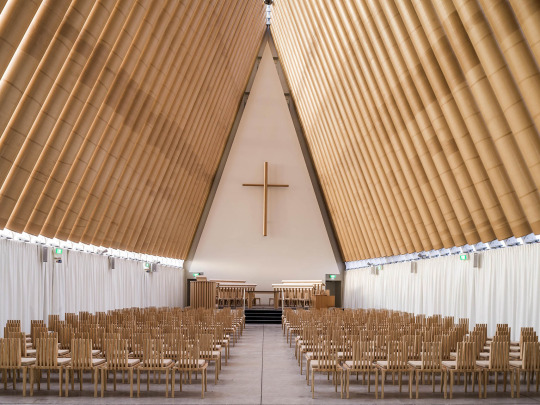
Cardboard Church, Christchurch, New Zealand (Yahoo UK, Photo: Courtesy of Shigeru Ban Architects )
“Japanese architect Shigeru Ban operates in extremes, creating everything from disaster housing made of beer crates to museums with price tags in the tens of millions of dollars. But whatever the cost, all of his projects have embraced simple materials and natural surroundings. Ten years before winning the Pritzker Architecture Prize in 2014, for example, Ban convinced the UN that his recycled-paper tube shelters could house refugees of the Rwandan civil war, a feat that eventually led to his TED talk on emergency shelters—and one that has made a lasting impact on the architecture world.” (Yahoo UK – Decor Contributors)
This is an example of how Japanese Innovation in Architectural Design can contribute to the world’s needs!! If you know of other interesting applications originating from Japan, please let us know!
Read more from: Paper Church from Shigeru Ban
Leave a comment | tags: cardboard churches, emergency shelters, GBMC, Japan, Japanese architects, Japanese Architecture, recycled paper churches, recycled paper houses, recycled paper shelters, Shigeru Ban | posted in Business, Japan, Social, Technology




 www.gbmc-blog.biz